
|
|||||||||||||
| Common name | Pomegranate | ||||||||||||
| Hebrew name |
 רימון מצוי
 |
||||||||||||
| أللّغة آلعربيّة | رمان | ||||||||||||
| Family | Lythraceae | ||||||||||||
| Leaf form | Simple | ||||||||||||
| Leaf margin | Entire | ||||||||||||
| צורת הגבעול | Round | ||||||||||||
| Life form | Tree | ||||||||||||
| Flowering months |
|
||||||||||||


|
|||||||||||||

|
|||||||||||||
|
|
||
|
||
|
||
Additional pictures: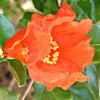 
|
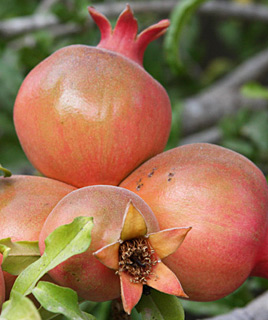
Additional informationPunica granatum (Pomegranate) is a small fruit tree, sometimes a shrub, deciduous, which reaches a height of 2-6 meters. It has decorative flowers and fruits. The pomegranate is common in fruit plantations, orchards and ornamental gardens. The ends of the branches are somewhat thorny. The leaves are alternate. The leaf is small, lanceolate, soft, somewhat wrinkled, with an entire margin. It is red when sprouting, and turns a characteristic yellow before exfoliation. Pomegranate blooms in the spring and its fruits ripen in the summer, according to the variety. The flower is bisexual, actinomorphic or almost actinomorphic. The flower is red, large, prominent and beautiful. It has a diameter of 5 cm, and is even longer. It has 6 leathery sepals that remain in the fruit, and adorn the head of the fruit with a royal crown. Their color is the same as that of the fruit shell, according to the variety and the growing conditions. The corolla is red its leaves are delicate and wrinkled. There are numerous stamens. There is no nectar, but a plentitude of pollen and the flower is pollinated by pollen-seeking insects. The ovary is inferior, arranged in two whorls, where the external one creates the upper part of the fruit and contains 5-9 concentric parts (loculi), where each is separated from its neighbors by a soft and transparent membrane, and the internal one creates the lower part of the fruit and always contains 3 loculi. There are numerous seeds, and each is enveloped separately by a juicy envelope, a type of pulp, that developed from the seed coat. It is pink or red, and affords the fruit its taste and fragrance. The fruit is spherical, with a diameter of 8-18 cm, and weighs about half a kilogram. The seeds are dispersed by birds that eat the seed pulp and excrete the hard part. Pomegranate does not grow wild in Israel. It apparently originates from northern Persia. It is grown for its edible fruit as well as for extracting its juice. It is also used for production of wine. Its cultivation in Israel has increased in recent years by the demand by consumers. Its health benefits are greatly appreciated. There are different varieties, some of them sour and some sweeter, some ripen earlier and some later in the season. The most common varieties are “Mule’s head” which has pink fruits and “wonderful” whose fruits are a brighter red. In addition to eating it as a fruit and drinking its juice, grenadine liquor and pomegranate wine are also produced from it. Dwarf varieties are grown in ornamental gardens. In the past, ink and medicines were prepared from its roots, bark and seeds. It is the only species in its genus. Written by Udi Michals and Mike Livne |
|
HeritageThe pomegranate, which is one of the seven kinds, was blessed with a juicy, tasty and special fruit as well as with an especially pretty color and shape. The pomegranate is mentioned often in the Bible and the Jewish literature, in its various uses: as food, as juice and as architectural ornamentation: in Solomon’s Temple, in the Sanctuary and in mosaics that were discovered (in which the pomegranate is identified as the current fruit), and as a metaphor for beauty and romantics, and for the fulfillment of religious commandments. The expression “full as a pomegranate” expresses a person with values, content and Torah. It is customary to eat pomegranates on Rosh Hashanah, so that we will fulfill as many religious commandments as there are seeds in the pomegranate. In the Song of Songs the maiden says to the youth: “I would cause thee to drink of spiced wine of the juice of my pomegranate” (Song of Songs 8: 2). The youth describes his love as follows: “As a piece of a pomegranate [are] thy temples within thy locks” (Song of Songs 6: 7). The pomegranate is a motif that is repeated in the ornamentation of the margins of the coat of the High Priest and in Solomon’s Temple: “and the pomegranates [were] two hundred in rows round about upon the other chapiter” (1 Kings 7: 20). The epitome of picturesqueness was awarded the pomegranate when the two spies carried it on a staff: “they bare it between two upon a staff; and [they brought] of the pomegranates, and of the figs” (Numbers 13: 23). |
Links |