






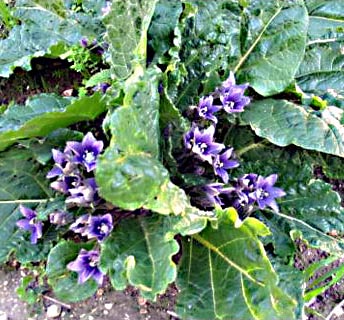

This perennial forb has a large rosette of dark green curled leaves and a thick taproot. The taproot splits sometimes and has a peculiar shape resembling a miniature person. This, together with its content of narcotic and hormonally active substances made it the topic of many legends and superstitions.
Leaf sprouting, from buds at the top of the thick storage root take place in early autumn. In an open space the leaves spread on the soil surface and assume a rosette that may reach a diameter of 50 cm. The central vein is lighter colored than the rest of the leaf blade. Leaf margin is dentate.
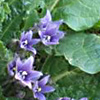
Blooming takes place in December-March. Each plant bears many large (2-3 cm) purple flowers that have a bell-shaped joint corolla with 5 lobes. Each flower has 5 sepals and 5 stamens.
The fruits are ball like and resemble small tomatoes. They are dark green at first and turn yellow and later orange when ripen. The ripe fruits have an intoxicating sweet odor. The fruits and especially the seeds contain a number of alkaloids that are highly toxic.
It is common in meadows throughout the Mediterranean region.
